From Globs to Glory: The Ultimate Guide to Stripping Furniture & Fixing Painting Mistakes
Table of Contents
- Why Stripping Furniture is a Non-Negotiable First Step
- The Stripping Showdown: Choosing Your Method
- Your Step-by-Step Guide to Flawless Furniture Stripping
- The Painter’s Pitfalls: 5 Common Mistakes & Their Easy Fixes
- Prepping Bare Wood for a Flawless Finish
- Essential Materials & Tools
- Frequently Asked Questions
- People Also Ask
I still cringe when I remember my first-ever furniture flip. It was a gorgeous, solid oak dresser I found on the curb, and in my rookie enthusiasm, I committed the cardinal sin of DIY: I painted directly over the old, chipping varnish. The result? A sticky, peeling, bubbly mess that looked worse than when I started. I had created a Frankenstein’s monster of furniture, and my dreams of a chic, custom piece were dashed. That disaster, however, was my greatest teacher. It forced me to learn the art and science of proper preparation, starting with the most crucial step of all: stripping it down to its beautiful, bare bones.
Many people think stripping furniture is a Herculean task, reserved only for seasoned professionals with workshops full of intimidating equipment. They see it as a messy, toxic, and time-consuming nightmare to be avoided at all costs. But what if I told you that’s a myth? What if I told you that with the right knowledge and tools, stripping furniture can be a deeply satisfying process that guarantees a professional, durable finish you’ll be proud of for years to come?
This guide is the culmination of years of trial, error, and triumph. I’m going to pull back the curtain and show you everything you need to know. We’ll walk through how to decide *if* you need to strip, how to choose the best method for your specific project, and a foolproof, step-by-step process for getting that perfect bare-wood canvas. And because we’ve all been there, we’ll also tackle the five most common painting mistakes and provide simple, effective fixes that can rescue almost any project from the brink. Get ready to say goodbye to frustrating finishes and hello to furniture that looks like it came straight from a high-end showroom.
Essential Materials & Tools
This post contains affiliate links. If you use these links to buy something, we may earn a commission. Thanks.
- Citrus-Based Paint & Varnish Stripper – Find on Amazon
- Chemical-Resistant Gloves – Find on Amazon
- Safety Goggles – Find on Amazon
- Plastic and Metal Scrapers – Find on Amazon
- Mineral Spirits – Find on Amazon
- Steel Wool (Fine & Medium) – Find on Amazon
- Orbital Sander & Assorted Sandpaper (80, 120, 220 grit) – Find on Amazon
- Tack Cloths – Find on Amazon
Why Stripping Furniture is a Non-Negotiable First Step
Before we dive into the ‘how,’ let’s tackle the ‘why.’ The temptation to skip stripping and just scuff-sand and prime is strong, I get it. It seems like a massive shortcut. But cutting this corner is often the very reason projects fail. The old finish on a piece of furniture is a barrier. It might be peeling, glossy, or incompatible with your new paint. Painting over it is like building a house on a shaky foundation—it’s destined to crumble.
So, when is stripping absolutely necessary?
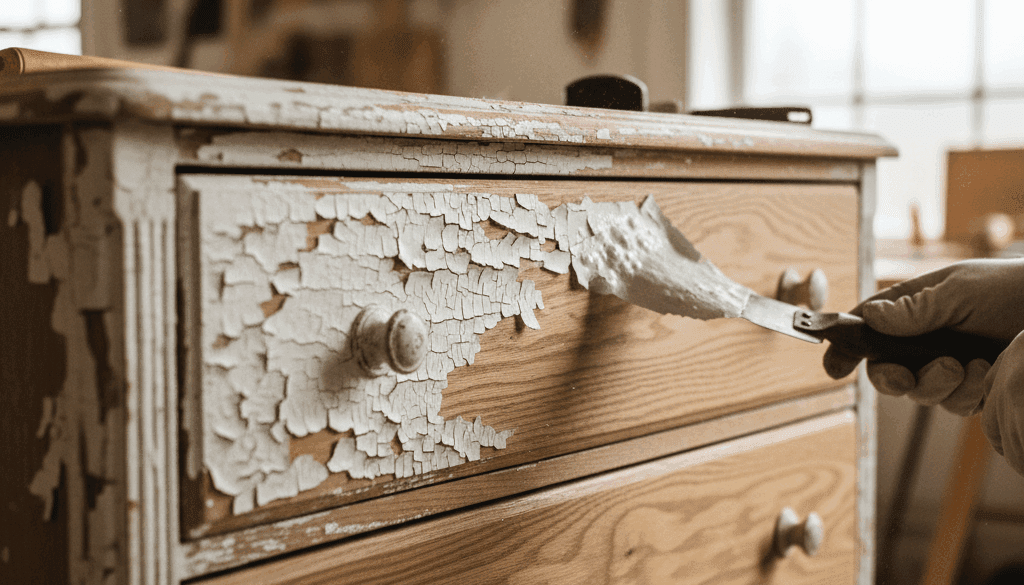
- When the existing finish is failing: If you see cracking, peeling, or alligatoring (a pattern of cracks resembling reptile skin), there’s no saving it. The bond between the old finish and the wood is broken. Painting over it will only result in your new paint peeling off right along with the old stuff.
- When you’re switching from paint to stain: This one is obvious. To let the natural beauty of the wood grain shine through with a stain, you have to remove every last trace of the opaque paint that’s covering it.
- When there are too many layers: If a piece has been painted half a dozen times over the decades, the details get clogged and the surface becomes uneven. Stripping away those layers restores the crisp edges and original character of the piece.
- When you don’t know what the old finish is: Is it oil-based? Latex? Lacquer? Shellac? Applying a new paint (especially a water-based one) over an old, unknown oil-based finish without proper prep can lead to poor adhesion, weird chemical reactions, and a finish that never fully cures. Stripping eliminates the guesswork and gives you a clean slate.

photo
There are, of course, times when a good cleaning and light sanding are sufficient. If you’re painting over a piece with a stable, matte-finish latex paint and the surface is in good condition, you can likely get away with a less intensive prep process. But for a truly professional, long-lasting transformation, especially on valuable or vintage pieces, stripping is the gold standard. It’s the difference between a project that looks good for a few months and an heirloom that will last for generations.
The Stripping Showdown: Choosing Your Method
Not all stripping methods are created equal. The best choice depends on your project, the type of finish you’re removing, and your comfort level with different tools and chemicals. Let’s break down the main contenders.
Method 1: Chemical Strippers
This is the most common and often most effective method, especially for pieces with intricate details or multiple layers of paint.
- Citrus-Based (Limonene): These are my go-to for most projects. They are less toxic, have a much lower odor, and are generally safer for indoor use (with good ventilation). The trade-off is that they work more slowly, often requiring several hours or even an overnight application to be effective.
- Solvent-Based (Methylene Chloride): These are the heavy-hitters. They work incredibly fast, often bubbling up paint in minutes. However, they are highly toxic, produce noxious fumes, and require serious safety precautions, including a respirator and excellent ventilation, preferably outdoors. Use these only when speed is critical and you can do so safely.
Pros and Cons of Chemical Strippers:
- Pros: Excellent for detailed areas, removes multiple layers at once, less physically demanding than sanding.
- Cons: Can be messy, requires safety gear, proper disposal is necessary, potential for harsh chemicals.
Method 2: Heat Gun
A heat gun works like a super-powered hair dryer, softening the paint so it can be easily scraped away. This is a great chemical-free option, but it comes with its own set of challenges.
Pros and Cons of a Heat Gun:
- Pros: No chemicals, works relatively quickly on flat surfaces, minimal mess.
- Cons: Fire hazard (you can scorch the wood or ignite the paint), not suitable for intricate details, can release lead fumes from old paint, requires a learning curve to avoid damaging the wood.
Method 3: Sanding
For some projects, particularly those with a thin, single layer of varnish, you might be able to strip the finish using only a sander. You’ll start with a coarse grit (like 60 or 80) and work your way up to a finer grit (150 or 220). This method is best for flat, simple surfaces.
Pros and Cons of Sanding:
- Pros: Chemical-free, provides a smooth, ready-to-paint surface in one step.
- Cons: Extremely dusty (a mask is essential), can easily damage veneers or round over sharp edges, very difficult to use on detailed or curved areas, can clog sandpaper quickly.

infographic
My personal recommendation for beginners is to start with a citrus-based stripper. It’s the most forgiving and safest option. For the flat surfaces of that same piece, you can then use an orbital sander to finish the job and create a perfectly smooth surface. This hybrid approach often yields the best results.
Your Step-by-Step Guide to Flawless Furniture Stripping
Alright, you’ve chosen your weapon. Now it’s time for battle. Here is the exact process I follow for a perfect strip every time using a chemical stripper, which is the most versatile method.
Step 1: Set Up Your Workspace
Work in a well-ventilated area, like an open garage or outdoors. Lay down a thick plastic drop cloth or cardboard to protect your floors. Remove all hardware (knobs, hinges) from the furniture and label them in plastic bags.
Step 2: Apply the Stripper
Put on your chemical-resistant gloves and safety goggles. Using a cheap, disposable paintbrush, apply a thick, generous layer of the stripper. Don’t be shy! A thin coat will dry out before it has a chance to work. Go in one direction and avoid over-brushing. Think of it like frosting a cake.

photo
Step 3: Wait Patiently
This is the hardest part. Read the manufacturer’s instructions for the recommended wait time. For citrus-based strippers, this can be anywhere from 30 minutes to 24 hours. To prevent it from drying out on long waits, you can cover the piece with plastic wrap. You’ll know it’s working when the paint starts to bubble and wrinkle.
Step 4: Scrape Away the Gunk
Using a plastic scraper (to avoid gouging the wood), gently push the gunk off the surface, moving with the grain of the wood. For detailed areas, use dental picks, old toothbrushes, or coarse steel wool. Have a cardboard box or bucket lined with a trash bag ready to collect the messy sludge.

photo
Step 5: Reapply if Necessary
For pieces with many layers, you may need a second application. Scrape off as much as you can, then apply another coat of stripper to the stubborn spots and repeat the process.
Step 6: The Clean-Up
Once all the finish is removed, you need to neutralize the stripper. The product instructions will tell you what to use. For most, this is mineral spirits or a product called ‘after wash.’ Wipe down the entire piece thoroughly with a rag soaked in the cleaning agent. This removes any remaining stripper residue that could interfere with your new finish.
Step 7: The Final Sand
Let the piece dry completely (at least 24 hours). The wood grain will likely be raised and feel a bit fuzzy. Do a final light sanding with 150-grit sandpaper, followed by 220-grit, to smooth everything out. Wipe away all dust with a tack cloth. Your piece is now officially stripped, prepped, and ready for its new life!
The Painter’s Pitfalls: 5 Common Mistakes & Their Easy Fixes
You’ve done the hard work of stripping, and now you’re painting. But what happens when things go wrong? Don’t panic. Almost every painting mistake is fixable. Here are the top five I see and how to solve them.
Mistake 1: Drips and Brush Strokes
- Cause: Applying paint too heavily, using the wrong brush, or not ‘tipping off’ (a final, light brush stroke to smooth the surface).
- The Fix (Wet Paint): Immediately brush them out with a nearly dry brush. For drips, use the tip of your brush to gently lift and smooth the excess paint.
- The Fix (Dry Paint): This requires a bit more work. Wait for the paint to cure completely (check the can, but usually 24-48 hours). Then, use 220-grit sandpaper to sand the drip or brush marks smooth. You can wrap the sandpaper around a small block of wood to keep the surface flat. Wipe away the dust and apply a thin, fresh coat of paint.
Mistake 2: Bubbling or Blistering Paint
- Cause: This is almost always a sign of contamination or moisture. Either the surface wasn’t perfectly clean (oil, grease), you’re painting in direct, hot sunlight, or there’s moisture trapped in the wood.
- The Fix: You have to remove the bubbles. Scrape them off, then sand the area smooth, feathering the edges into the surrounding paint. Clean the area thoroughly with a 50/50 mix of denatured alcohol and water. Let it dry completely. Then, prime just the patched area before applying a fresh coat of paint.

photo
Mistake 3: Peeling or Chipping Paint
- Cause: Poor adhesion. This happens when you paint over a dirty, glossy, or oily surface, or if you didn’t use the right primer (e.g., painting latex over oil-based paint without a bonding primer).
- The Fix: There’s no shortcut here. You must scrape and sand off all the loose, peeling paint. Sand until you have a smooth, solid surface. Feather the edges. Clean the area, then apply a high-quality bonding primer. Once the primer is dry, you can repaint.
Mistake 4: Uneven Sheen (Flashing)
- Cause: You see this when some spots look glossier than others. It’s often caused by applying a second coat before the first is fully dry, painting over an unprimed or porous surface, or variations in paint thickness.
- The Fix: The easiest fix is to apply another coat of paint. Make sure your application is even and consistent. If the problem persists, the underlying surface may be the issue. Lightly sand the entire surface to de-gloss it, then apply a coat of primer to seal it before your final coat of paint.
Mistake 5: Tacky or Sticky Finish
- Cause: The paint isn’t curing properly. This can be due to high humidity, low temperatures, applying coats too thickly, or a chemical reaction with something underneath.
- The Fix: First, give it more time. Sometimes paint just needs a few extra days in a warm, dry environment. Increase air circulation with a fan. If it’s still tacky after a week, you may need to strip it off and start again. I know that’s painful to hear, but a finish that won’t cure will attract dust and never be durable. This is often a sign that stripper residue was left on the piece, which is why the mineral spirits cleaning step is so critical.
The Final Touch: Prepping Your Bare Wood for a Flawless Finish
Congratulations, the stripping is done! You have a beautiful, raw wood canvas. But don’t grab that paintbrush just yet. This final preparation stage is what separates the amateurs from the pros. It ensures your primer and paint adhere perfectly and give you that buttery-smooth finish you’re dreaming of.
First, do a final inspection. Run your hand over the entire surface (with a glove on is fine). Do you feel any rough patches or fuzzy spots? These are areas where the wood grain was raised during the stripping and cleaning process. Use 220-grit sandpaper to give the entire piece one last, light sanding. The goal isn’t to remove wood, but simply to knock down those raised fibers. Always sand in the direction of the wood grain to avoid creating cross-grain scratches that will show through your final finish.
Next comes the most important cleaning of the entire project. All the microscopic dust from sanding needs to be removed. A vacuum with a brush attachment is a good first pass. But the secret weapon is a tack cloth. A tack cloth is a sticky piece of cheesecloth that grabs and holds onto every last speck of dust. Gently wipe down every surface you plan to paint. You’ll be amazed at how much dust it picks up even after vacuuming.
Now, let’s talk primer. Is it really necessary on bare wood? Yes, 100%. Primer does three critical things:
- It seals the wood: Bare wood is thirsty. Without a primer, it will soak up your expensive paint unevenly, leading to a blotchy finish.
- It ensures adhesion: Primer is formulated to grip onto wood and create the perfect surface for paint to stick to.
- It blocks stains and tannins: Woods like oak and mahogany contain natural oils called tannins that can bleed through water-based paints, creating yellowish or pinkish stains. A good stain-blocking primer (like a shellac-based or oil-based one) prevents this from happening.
Apply one or two thin, even coats of your chosen primer. Let it dry completely according to the manufacturer’s instructions. Give it a very light scuff-sand with 220-grit sandpaper and one last wipe with a tack cloth. Now, and only now, are you truly ready to paint. This meticulous prep work might seem tedious, but I promise you, when you glide that first perfect coat of paint onto the flawlessly prepped surface, you’ll know it was all worth it.
Frequently Asked Questions
Is it safe to use chemical strippers indoors?
It’s highly recommended to work outdoors or in a very well-ventilated space like an open garage. If you must work indoors, use a less-toxic citrus-based stripper, open all windows, use fans for cross-ventilation, and wear a respirator with organic vapor cartridges to be safe.
How do I know when all the old finish is gone?
After scraping, the wood might still look splotchy. The key is the cleaning step with mineral spirits. As you wipe it down, the wood should look uniformly damp and clean. Once it dries, if you see shiny or sealed-looking patches, those areas still have finish on them and may need another spot-application of stripper.
Can I use a power sander to strip the entire piece of furniture?
While a power sander is excellent for flat surfaces like tabletops, it’s generally a bad idea for an entire piece. It’s very aggressive and can easily ruin details, round over crisp edges, and even sand through thin wood veneers. It’s best used as a finishing tool after the bulk of the old paint or varnish has been removed chemically.
What is the best way to dispose of chemical stripper and old paint sludge?
Never pour it down the drain or throw it in the regular trash. The stripper-and-paint gunk is considered household hazardous waste. Scrape the sludge into a cardboard box or can, let it dry out and harden completely, and then contact your local waste management facility for instructions on hazardous waste drop-off days or locations.
People Also Ask
What is the easiest way to strip paint from wood?
For most DIYers, the easiest and most effective method is using a citrus-based chemical stripper. It requires less physical effort than sanding, is safer than harsh solvent-based strippers, and is more effective on detailed or curved areas than a heat gun. Apply a thick coat, wait for it to bubble, and scrape it off.
Can you paint over stripped wood without priming?
It is not recommended. Bare wood is porous and will absorb paint unevenly, resulting in a blotchy finish. It also contains natural oils and tannins that can bleed through and stain your paint. A primer seals the wood and blocks stains, creating a uniform surface for perfect paint adhesion and a durable finish.
How long after stripping wood can you paint it?
You must ensure the wood is completely dry before priming and painting. After cleaning the stripped wood with mineral spirits or an after-wash, you should wait at least 24-48 hours. If the wood feels cool to the touch or looks dark, it still contains moisture.
Does vinegar remove paint from wood?
Vinegar can soften and remove very small, fresh splatters of latex paint. However, it is not an effective method for stripping an entire piece of furniture with cured paint or varnish. For significant paint removal, you will need a commercial paint stripper, heat gun, or extensive sanding.
Conclusion
Transforming a piece of furniture is one of the most rewarding DIY projects you can undertake. It’s a journey from ‘before’ to ‘after’ that ends with a custom piece full of character. The secret, as we’ve seen, isn’t in a magic brush or expensive paint—it’s in the patient, methodical work of preparation. By learning to strip a piece down to its bare essence, you give it the best possible foundation for a stunning new look. And by understanding how to fix the inevitable little mistakes along the way, you empower yourself to aim for perfection without fear. Now you have the complete roadmap to success. What’s the first piece of furniture you’re planning to transform with these techniques? Share your project ideas in the comments below!